

Learning a new language has never been easier. With AI-powered apps, interactive lessons, and real-time translation tools, you can study almost anywhere. From your morning commute to your next overseas holiday.
But with so many options available, one question remains:
What is the best language learning app?
The answer depends on your goals. Some apps are excellent for building vocabulary, others focus on grammar, while newer AI-powered tools help you sound more like a native speaker.
Here's a comparison of some of the best language learning apps available today.
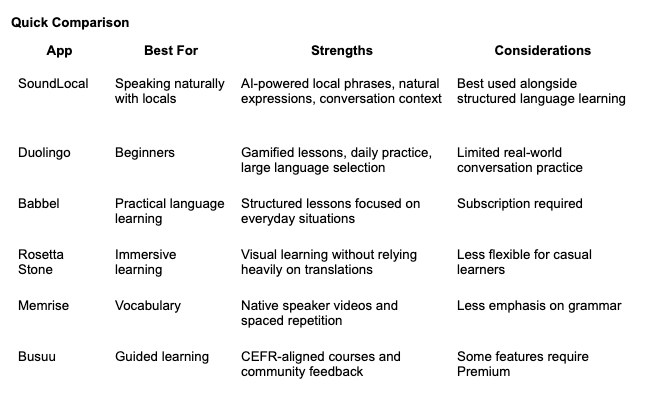
1. SoundLocal
If your goal is to sound like a local instead of a translation app, SoundLocal offers a different approach to language learning.
Rather than teaching isolated vocabulary lists, SoundLocal helps you understand how native speakers actually communicate.
Features include:
Natural local expressions
Casual and formal alternatives
Regional variations
Real conversation examples
AI-powered phrase suggestions
Context-aware translations
For example, instead of simply translating a sentence, SoundLocal shows several authentic ways locals would naturally express the same idea, helping you speak more confidently in everyday situations.
Best for:
Travellers
Digital nomads
Exchange students
Expats
Professionals working internationally
2. Duolingo
Duolingo remains one of the world's most popular language learning apps. Its bite-sized lessons and game-like approach make it easy to build a daily learning habit.
Pros:
Free to start
Fun and engaging
Large number of languages
Excellent for beginners
Limitations:
Can feel repetitive
Less emphasis on natural conversations
Doesn't always prepare learners for real-life speaking
3. Babbel
Babbel focuses on practical conversations you'll actually use.
Lessons are created by language experts and progress logically through grammar, vocabulary, listening, and speaking.
Pros:
Real-world conversations
Well-structured courses
Strong grammar explanations
Best for learners who want a more traditional classroom-style experience.
4. Rosetta Stone
Rosetta Stone pioneered immersive language learning by teaching without relying heavily on your native language.
It encourages learners to associate words directly with images and situations.
Pros:
Immersive learning
Excellent pronunciation tools
Long-established methodology
Ideal for learners who enjoy structured, immersive study.
5. Memrise
Memrise focuses on helping users remember vocabulary using spaced repetition and videos of native speakers.
Pros:
Excellent vocabulary retention
Authentic pronunciation
Short daily lessons
Great for expanding vocabulary quickly.
6. Busuu
Busuu combines structured lessons with feedback from native speakers.
Its courses align with international language proficiency standards, making it popular among learners preparing for exams or professional use.
Pros:
Community corrections
Structured curriculum
Clear progression
What makes a great language learning app?
When choosing the best language learning app, consider whether it helps you:
Build vocabulary
Understand grammar
Improve pronunciation
Practice listening
Gain speaking confidence
Learn natural expressions
Understand cultural context
The best apps often specialize in one or two of these areas rather than trying to do everything.
Why Natural Conversations Matter

Many learners can read and understand a language but still struggle to sound natural when speaking.That's because native speakers rely on:
Idioms
Everyday expressions
Cultural references
Tone
Context
Regional variations
Traditional language apps may teach what is grammatically correct, but they don't always teach what people actually say.
This is where SoundLocal stands apart by focusing on authentic communication instead of literal translation.
Which language learning app should you choose?
Choose Duolingo if you're just starting and want a fun daily habit.
Choose Babbel if you prefer structured lessons with practical conversations.
Choose Rosetta Stone if you enjoy immersive learning.
Choose Memrise if your focus is vocabulary retention.
Choose Busuu if you want feedback from native speakers and guided progression.
Choose SoundLocal if your priority is communicating naturally and confidently with locals in real-world situations.
Many learners will benefit from using two complementary apps. A structured course for grammar and vocabulary, alongside SoundLocal to learn how native speakers actually express themselves.
Final Thoughts
The best language learning app is the one that matches your goals.
If you're preparing for exams, a structured course may be ideal.
If you're traveling, working abroad, or simply want conversations to feel more natural, learning authentic expressions is just as important as memorizing vocabulary.
SoundLocal fills that gap by helping learners move beyond textbook translations and speak with the confidence and authenticity of someone who understands how locals really communicate.
10 Travel mistakes you can avoid by learning local expressions
Avoid common travel mistakes by learning local expressions. Discover 10 simple ways to communicate naturally and enjoy more authentic travel experiences.
SoundLocal vs Google Translate vs DeepL vs ChatGPT: Which language app helps you sound like a native?
Compare SoundLocal, Google Translate, DeepL, and ChatGPT to discover which language app helps you sound more like a native speaker.