

If you've ever spoken a foreign language only to have the other person immediately switch to English, you're not alone.
Most language learners know enough vocabulary to communicate. The problem isn't what they're saying. It's how they say it.
Translation apps have become incredibly accurate, but accuracy isn't the same as sounding natural. Native speakers don't simply translate words. They choose phrases, expressions, tone, and context instinctively.
That's where choosing the right language app matters.
In this guide, we'll compare SoundLocal, Google Translate, DeepL, and ChatGPT to help you decide which tool best fits your goals.
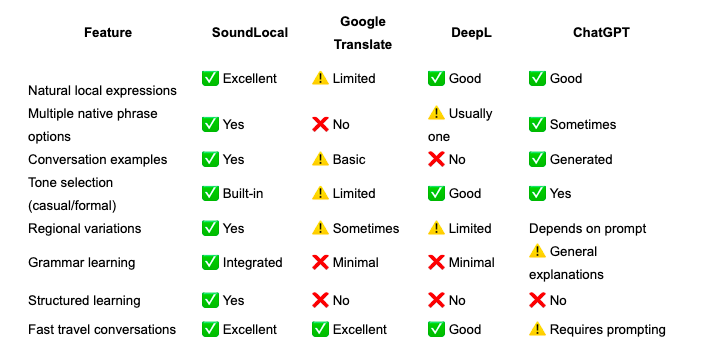
Quick comparison
SoundLocal
SoundLocal is designed around a simple idea:
People don't want literal translations. they want to sound like locals.
Instead of giving a single translation, SoundLocal provides:
- Multiple authentic phrase variations
- Usage rankings
- Casual and formal alternatives
- Conversation examples
- Level-appropriate vocabulary
- Real world context
- Regional language differences
For example, instead of translating:
"I can't wait to try the local food"
SoundLocal may show several ways native speakers express the idea, highlighting which version people use most often.
This helps learners understand not just what is correct, but what sounds natural.
Best For
- Travelers
- Exchange students
- Professionals working overseas
- Expats
- Anyone who wants conversations to feel authentic

Google Translate
Google Translate remains one of the fastest translation tools available. Its strengths include:
- instant translation
- camera translation
- voice recognition
- offline support
- over 100 languages
For finding out what a sign says or translating a menu, it's difficult to beat.
The downside is that translations often sound literal.
Many learners discover that while Google Translate produces grammatically correct sentences, native speakers would rarely use those exact words naturally.
Best For
- Quick translations
- Reading foreign text
- Travel emergencies
DeepL
DeepL has built a reputation for producing smoother, more natural translations than many competitors. Its translations are often read more fluently, especially in European languages.
However, DeepL generally focuses on producing one polished translation, rather than explaining alternative expressions or when locals might choose one phrase over another.
For writing emails or documents, DeepL performs exceptionally well. For learning how people actually speak every day, it provides less context.
Best For
- Professional writing
- Business communication
- Document translation
ChatGPT
Many language learners now use ChatGPT as a conversation partner.
It can:
- explain grammar
- create practice conversations
- adjust tone
- answer language questions
- rewrite sentences
Its biggest strength is flexibility. The challenge is consistency. You need to know what to ask.
For example: "Translate this naturally for someone in Barcelona using casual language."
Without detailed prompts, responses may vary. ChatGPT is excellent as a tutor, but less streamlined for fast, everyday language lookups.
Best For
- Language explanations
- Conversation practice
- Custom learning
Feature Comparison
1. Sounding Natural
This is where SoundLocal stands out. Rather than asking:
"Is this translation correct?"
It answers:
"How would locals actually say this?"
That's a subtle but important difference. Instead of textbook phrases, users receive expressions commonly used in everyday conversations.
2. Learning Through Context
Most translation tools stop after producing sentences.
SoundLocal continues by showing:
- conversation examples
- likely responses
- when to use each phrase
- tone differences
This helps learners build confidence before speaking.
3. Multiple Ways to Say the Same Thing
Native speakers rarely have only one way to express an idea.
SoundLocal offers several authentic alternatives ranked by common usage, making it easier to choose the right phrase for the situation.
4. Designed for Real Conversations
Many language apps focus on vocabulary. SoundLocal focuses on communication.
Whether you're:
- meeting locals
- ordering food
- attending business meetings
- making friends abroad
The emphasis is on helping conversations feel natural rather than translated.
Which App Should You Choose?
Choose Google Translate if you need quick translations while traveling.
Choose DeepL if you translate professional documents.
Choose ChatGPT if you want a flexible AI language tutor.
Choose SoundLocal if your goal is to stop sounding like a translation app and start sounding like someone who understands how native speakers communicate.
Final Verdict
The best language tool depends on what you're trying to achieve.
If your goal is simply understanding another language, almost any modern translation app can help.
But if your goal is having smoother conversations, making better first impressions, and avoiding awkward textbook phrasing, you need more than direct translation.
You need context, tone, cultural awareness, and authentic local expressions.
That's exactly what SoundLocal is built to provide. Helping you communicate in ways that feel natural, confident, and genuinely local.
Best language learning app in 2026: Which one is right for you?
Discover the best language learning apps of 2026. Compare SoundLocal, Duolingo, Babbel, Rosetta Stone, Memrise, and Busuu.
Why every traveler should download SoundLocal before your next trip
Travel like a local with SoundLocal. Learn natural phrases, communicate confidently, and create authentic connections on every trip.